

Economic, sustainable, and behavioural developments shaping the sector today.
In this article, you will read:
- Why hotels in 2026 must focus on new revenue streams, PIPs, ESG, and soft branding
- How sustainable menu design helps guests choose without extra explanation or resistance
- How economic resilience and sustainable guest behaviour are becoming increasingly intertwined
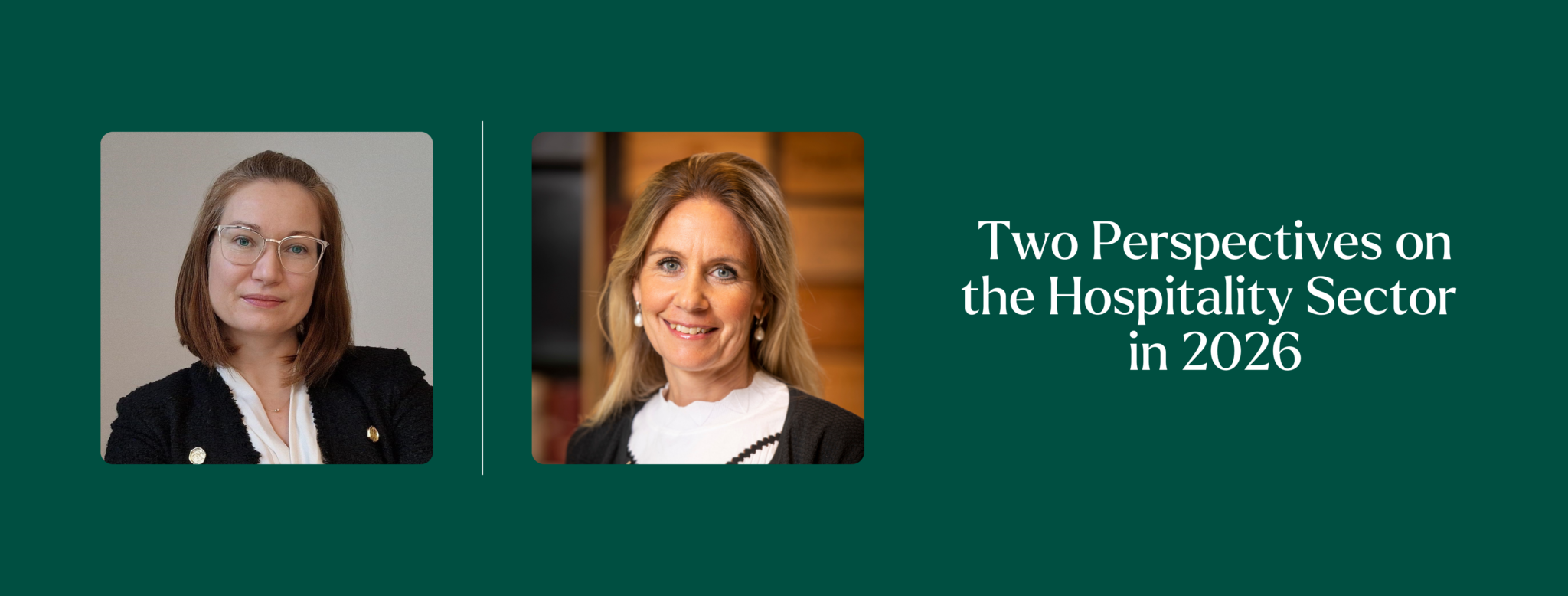
The first weeks of 2026 are behind us, and the key developments in the hospitality sector are becoming increasingly clear. Traveller behaviour is shifting, sustainable expectations are evolving, and economic pressure calls for strategic adjustments. In this article, two experts affiliated with Hotelschool The Hague, lector (professor) of Hospitality Business Melinda Ratkai and Lector (professor) in Responsible Consumption Anna de Visser Amundson, share their perspective on the trends shaping the industry. Their analyses show how financial policy, guest experience, and sustainable design are becoming more interwoven and what opportunities this creates for organizations that want to look ahead.
Financial and Economic Issues Hotels Must Prepare for in 2026
In 2026, the hospitality sector is driven primarily by three factors: changing traveller behaviour, stricter ESG expectations, and the need for hotels to develop new revenue streams.
By Melinda Ratkai, lector (professor) Hospitality Business
The hotel sector faces a year in which strategic adaptation is essential. International travel is expected to decline, which may place pressure on RevPAR (Revenue per Available Room). Domestic tourism remains strong, with a growing preference for multi‑generational travel and distinctive experiences. Hotels offering integrated wellness programmes, spa services, kids’ clubs, and curated activities achieve higher ADRs (Average Daily Rates) in 2026. These services are no longer simply operational add‑ons; they are evolving into essential, independent revenue streams that support a more stable cash flow.
Additional resilience emerges when hotels actively collaborate with local communities on food and beverage, wellness concepts, and events. Particularly during seasonal fluctuations or periods of reduced tourist demand, this local integration proves to be a strategic advantage.
Soft branding is also gaining momentum. Independent hotels are increasingly combining the reliability of international brands with the authenticity of local identity. Examples include Marriott’s Series, Hilton’s Outset Collection, and Marriott Bonvoy’s Outdoor Collection. For owners, this results in improved distribution and pricing power, without the full operational obligations of traditional branding. For major brands, it offers cost savings — especially now that borrowing costs for construction finance and commercial mortgage‑backed debt are higher.
Capital investments are shifting towards Property Improvement Plans (PIPs) and repositionings that demonstrate resilience, scalability, and clear ESG objectives. Although ESG compliance may at times appear less visible, investor expectations are rising: they want demonstrable impact. Certifications such as LEED, WELL, and BREEAM are becoming baseline standards, and operating contracts increasingly include ESG KPIs to enforce accountability. Real estate without PIPs or a clear ESG strategy risks valuation discounts — creating opportunities for opportunistic investors.
In summary: 2026 rewards hotels that broaden their revenue sources, adopt flexible branding strategies, and invest in ESG‑driven initiatives. Organisations that respond proactively to shifting travel patterns and investment priorities — while integrating local communities — are building sustainable, future‑proof growth.
How to Design Sustainable Menus in 2026
By Anna de Visser Amundson, Lector (professor) Responsible Consumption
Alongside economic shifts, there is a behavioural transition among guests that is equally influential. Moving into 2026, sustainable hospitality is shaped less by regulation and more by what guests now consider standard. The trend known as climate fatigue is becoming more pronounced: people are aware of climate challenges but have limited mental capacity to reassess “the right choice” every time.
At the same time, climate convergence is emerging: sustainability is no longer a separate theme but a quiet default that aligns with quality, trust, and convenience.
Guests expect fewer explanations and more intuitive guidance — not through moralising messages but through intelligently designed menus and standard options. Sustainability must be embedded within the system as a seamless, almost invisible choice, rather than something that needs to be actively promoted. This signals a fundamental shift: influencing behaviour through design rather than argumentation.
A clear example is positioning plant‑based dishes as the default across menus, packages, buffets, and banqueting, with meat offered as an optional add‑on. This structurally reduces CO₂ impact without guests feeling that anything is being imposed on them. Research also shows that when 50–70% of a menu is plant‑based, guests naturally choose these options more often. Menu placement is crucial: vegetarian dishes are selected more frequently when they appear at the top or within the first decision block.
Language and positioning also deserve careful consideration. Sustainable dishes — including meat alternatives — are better received when presented as complete dishes with their own culinary identity. The focus shifts to flavour, experience, provenance, and the chef’s craftsmanship, rather than what the dish is not. Organisations that understand and experiment with this build a clear advantage in 2026, as sustainable choices become appealing, effortless, and intuitive.
Sustainable menu design proves to be one of the most effective ways to influence guest behaviour, as small design choices often achieve greater impact than communication or awareness campaigns.
Two perspectives that reinforce each other
Despite differing starting points, the insights of Ratkai and De Visser Amundson reveal a strong connection: economic resilience and sustainable guest behaviour strengthen one another. New revenue streams, higher ADRs, and stronger valuations go hand in hand with a guest experience in which sustainability is seamlessly and attractively integrated. Hotels that combine economic flexibility with thoughtful sustainable design are building a robust, future‑proof model in 2026.
Summary
Together, the two perspectives present a broad yet coherent view of what defines the hospitality sector in 2026. The combination of economic strategy and sustainable guest behaviour demonstrates that today’s challenges require integrated solutions. The insights of Ratkai and De Visser Amundson offer a valuable foundation for organisations seeking to look ahead and determine their strategic direction in a year characterised by both movement and opportunity.
----------------------------------------------
About the Authors
Dr Melinda Ratkai is Lector (professor) of Hospitality Business at Hotelschool The Hague. She earned her PhD in 2014 at the University of Huelva (Spain), specialising in SME management and economics. Her expertise lies in corporate governance and sustainable finance. With over ten years of experience in management economics and digital accounting, she focuses on sustainability reporting and ESG‑driven business practices within the hospitality sector.
Dr Anna de Visser Amundson is Lector (professor) in Responsible Consumption at Hotelschool The Hague. She studied International Hospitality Management at Les Roches and holds an MSc and PhD from Vrije Universiteit Amsterdam. Her research focuses on sustainable consumption behaviour and circular food systems, for which she received an NWO grant and an Erasmus+ Capacity Building project. She publishes in international journals including the Journal of Marketing Research and Journal of Sustainable Tourism, and works closely with companies and students to bring sustainable food concepts into practice.
News
WE ARE WHAT’S NEXT
Research
When will humanoid robots start cleaning my hotel room?

Alumni
From Classroom to Career: Hotelschool The Hague Alumni Stories | meet Elena
Alumni
From Classroom to Career: Hotelschool The Hague Alumni Stories | meet Jeroen

Alumni
From Classroom to Career: Hotelschool The Hague Alumni Stories | meet Nat

Alumni
From Classroom to Career: Hotelschool The Hague Alumni Stories | meet Natalie
See more
Blog posts