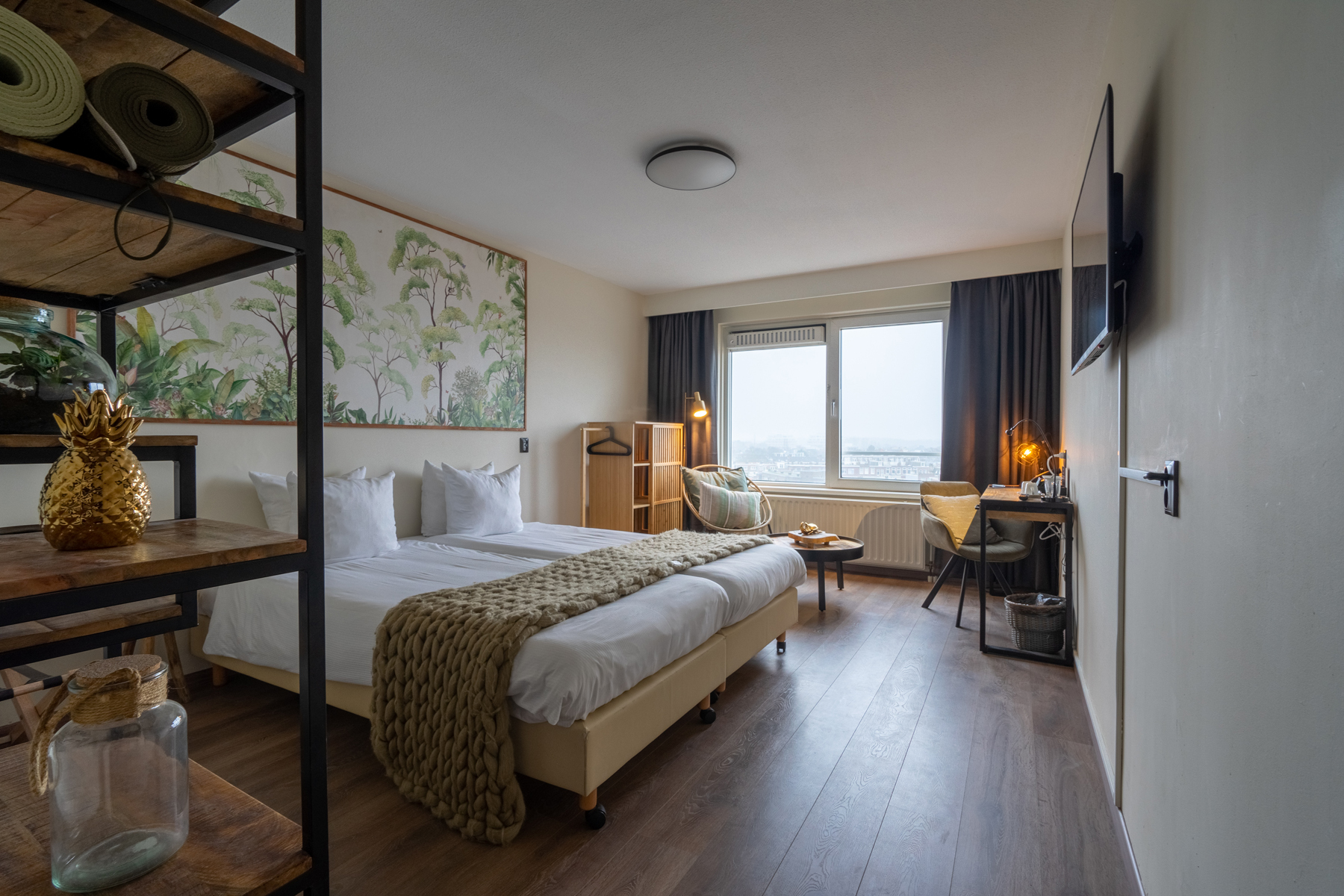

A realistic look at humanoid robotics, labour economics, and realistic expectations for hotel operators.
As we enter 2026, humanoid robots are no longer a futuristic concept. They are being tested in factories, warehouses, and even domestic environments. With labour shortages still pressuring hospitality operations, the question is no longer if robots will enter hotels, but where and when. This article explores what that really means for housekeeping, kitchens, and hotel operations.
This article is published by HospitalityNET, here: https://www.hospitalitynet.org/opinion/4130361.html
In recent years, massive leaps have been made in the development of humanoid robots. The idea of making mechanical humans that can do our chores for us is as old as Talos, the fictional bronze man that was thought up by the ancient Greeks in 300 B.C. However, recent developments in robot building might make human-shaped robots a real possibility in people’s houses in the near future, and possibly also in our professional work environments.
Humanoids for hospitality
Having robots perform tasks makes a lot of logical sense for hotels and restaurants, as hotels continue to struggle with personnel shortages and employee turnover. These shortages are most pronounced in physically demanding job types such as housekeeping or kitchen work. If instead of hiring a human employee, a manager could put in a robot who can perform the same tasks, but is never ill, can work double shifts seven days a week (if it is properly charged) and will never seek out a different career path, these employment issues would be over quickly. The costs of complex walking robots are still high at this point but are said to go down as more competitors enter the market over time.
The development of humanoids
If humanoids were a no-brainer for hospitality executives to deploy, why are they not being used today? This is because the developers of these robots are still busy teaching them as many tasks as possible. In recent videos, we can see Tesla’s Optimus robots learning simple tasks like picking up items and pushing buttons in a factory. This teaching is done by having humans execute a task, and the robots imitating the humans. If we extrapolate this process, humanoid robots will be able to do the same work as humans in due time. The humanoid robot company NEO is also thinking along these lines. Their vision for domestic humanoids is that consumers can order a robot to do chores around the house from early 2026 onwards. Any task the robot cannot do will then first be done remotely by a NEO employee operating the robot from a distance. From the data collected during this process, the robot can then learn to do the task autonomously. Easier tasks, like opening a door, are quickly learned, and harder tasks will take longer.
How easy is hospitality work for humanoids?
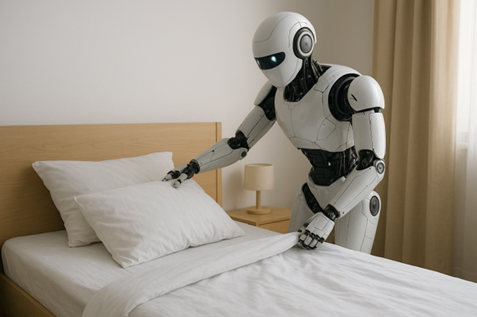
In physical hospitality work, there are many tasks that might be hard for humanoid robots to perform. Chopping vegetables, for example, considers grasping oddly shaped objects that can be deformable or have bad spots that should be identified to not end up in guests’ food. Similarly, making a hotel bed consists of picking up many deformable objects like blankets, mattresses and pillows that are also heavy and large (a king size duvet can be up to 2.5 meters in width, which is more than any humanoid’s span). Also important to consider is the speed at which humanoid robots would be required to work in commercial hotels. It is one thing to have a robot being able to clean a bathroom, but quite another to have it do it as fast as a human housekeeper.
Who is getting replaced?
There is another important factor to consider and that is the competitiveness of humanoids compared to human labor. Humanoids are still in their developmental stages, which makes them expensive. Their costs will go down as they become more mainstream, and more companies will start implementing them. For a manager that is considering replacing human workers with humanoids that can do any task, the costs for the robot are compared to the costs of the human and the most profitable option is chosen. In this way of thinking, the jobs that will get automated first are the ones with the highest wages, because they will result in the most direct gains.
So, when will humanoids start cleaning my hotel room?
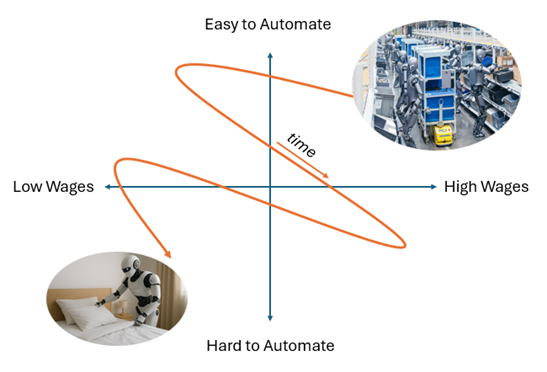
To accurately predict when humanoids will be viable alternatives for hotel and restaurant work, we should merge the two lines of thinking that were presented earlier. Figure 2 shows four quadrants representing jobs that are easy and hard to automate, and jobs that are well or less well paid. The jobs that humanoids will take first are the ones that are easy to do for humanoids in their current form and that have well paid humans performing it. Then, over time, more tasks will be possible for robots to do, and robots will become cheaper. Slowly, every job could be replaced at some point in time. Given developments in AI, and the number of companies that are starting to develop and work with humanoids, the speed of this transition is difficult to assess. At the start of it are jobs that robots can take easiest in which employees are paid well, such as high-tech assembly work. Tesla also states that part of its goal for humanoids is to operate the Tesla car factories. Slowly, both the tasks that robots can perform adequately will start to get more complex and simultaneously, as humanoids become cheaper and faster, it will be viable for them to replace less well compensated workers. However, physical housekeeping and cooking jobs are at the very end of this process, which means that we will probably not see humanoids replacing them in the near future.
--------------
About Klaas Koerten
Klaas Koerten is a researcher at Hotelschool The Hague Research Centre, conducting applied research on hospitality operations, labor and technological solutions to support hospitality employees. Through close collaboration with industry partners, like Minor Hotels, his work supports hotel professionals in making informed decisions about innovation and operational change
Recent publication
A low-tech innovation and its positive impact upon housekeeping in hotel staff

Research
Two Perspectives on the hospitality sector in 2026

News
WE ARE WHAT’S NEXT

Alumni
From Classroom to Career: Hotelschool The Hague Alumni Stories | meet Elena
Alumni
From Classroom to Career: Hotelschool The Hague Alumni Stories | meet Jeroen

Alumni
From Classroom to Career: Hotelschool The Hague Alumni Stories | meet Nat

Alumni
From Classroom to Career: Hotelschool The Hague Alumni Stories | meet Natalie
See more
Blog posts